In August 2023, scientists at the University of California, Berkeley, achieved a groundbreaking feat by reconstructing Pink Floyd’s “Another Brick in the Wall” from the brain activity of patients listening to the song. This was the first time a recognizable song was reconstructed from neural signals, marking a significant advancement in neural decoding research.
However, such achievements are confined to controlled laboratory settings and are not yet applicable for widespread use. The technology requires invasive procedures, such as implanting electrodes, and is currently limited to specific medical contexts.
For broader applications, companies often rely on signal analysis — a non-invasive method that interprets user intentions based on observable behaviors like voice tone, facial expressions, and body movements. Unlike neural decoding, which attempts to access internal thoughts, signal analysis focuses on external cues to forecast user actions.
It’s important to note that the term “mind-reading AI” is often used as a marketing tool. Current technologies do not access the brain’s internal thoughts but instead analyze patterns in user behavior. While these systems can suppose intentions with a degree of accuracy, they do not equate to true telepathy which is solely human thing… for now.
What Is Telepathy?
Telepathy is the ability to transmit thoughts from one person to another, or to receive them— a phenomenon not recognized by official science. No sensory organs or instruments are involved in the process.
Belief in the possibility of transmitting thoughts is supported by several relatively successful experiments in which the results were significantly higher than would be expected from random guessing.
Such phenomena may be the result of a long evolutionary process, a legacy that humans have partially lost. However, this ability can potentially be restored, for example through telepathy training at VEREVIO.
While telepathy is described as a direct transfer of thoughts between people, modern AI approaches the mind through measurable signals.
What Is Signal Analysis?
AI researchers are learning how to analyze brain signals — tiny electrical patterns your brain makes when you think, see, or imagine something. This is called signal analysis: the AI looks for patterns in these signals to guess what a person might be thinking or planning.
Some labs have done experiments:
- MIT used EEG signals to predict simple hand movements.
- Berkeley tried to reconstruct basic images people were looking at using fMRI.
- Kyoto University studied brainwaves to detect imagined words.
Sounds impressive, right? But here’s the truth: these AI systems do not read your mind. They only find correlations between brain activity and certain actions or images in very controlled experiments. Outside the lab, these guesses would fail almost all the time.
Looking Ahead: AI, Human Cognition, and Ethical Considerations
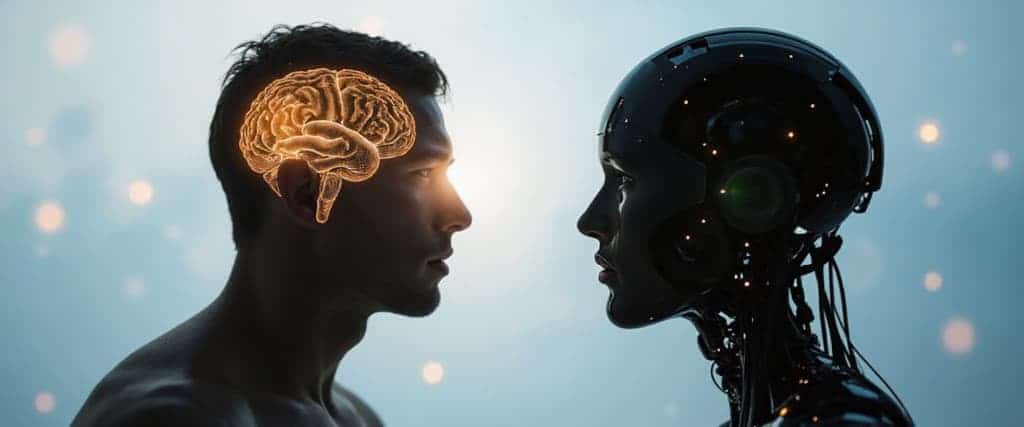
While AI cannot truly read minds, the growing sophistication of signal analysis raises intriguing possibilities for the future. Advances in neural decoding, behavioral monitoring, and machine learning may allow AI systems to anticipate decisions, detect emotions with high precision, or even suggest interventions in healthcare, education, and human–computer interaction.
Imagine a system that can detect stress or anxiety before a person is consciously aware of it, offering timely guidance or support. Similarly, AI could enhance accessibility tools, allowing people with disabilities to communicate more effectively through patterns in gestures, speech, or neural signals.
However, these possibilities also highlight a crucial distinction: AI predictions remain probabilistic, not deterministic. Unlike telepathy, which in theory involves instantaneous and complete knowledge of another person’s thoughts, AI operates on correlations and patterns.
It can make highly educated guesses under controlled conditions, but the complex, context-dependent nature of human cognition means uncertainty is always present. This limitation must be clearly understood when deploying AI in real-world settings, particularly when decisions or interventions rely on inferred intentions or emotional states.
The societal implications are equally significant. As AI systems become more adept at analyzing human behavior, questions of privacy, consent, and autonomy gain prominence. Unlike telepathy, which is largely theoretical and personal, AI signal analysis can be recorded, stored, and shared. This raises potential ethical concerns: Who controls this data?
How accurate are the forecasts? And to what extent should AI-generated insights influence decisions about people’s lives? Developing clear guidelines and ethical frameworks will be essential to ensure these technologies complement human abilities without undermining trust or personal freedom.
Finally, studying both AI and telepathy — real or imagined — offers insights into the boundaries of human cognition and technology. Telepathy, if it exists, remains a uniquely human phenomenon, emphasizing intuition, empathy, and consciousness. AI, in contrast, demonstrates how measurable signals can be interpreted to approximate aspects of thought.
Together, they show two parallel approaches to understanding the mind: one rooted in human experience, the other in computation and observation.